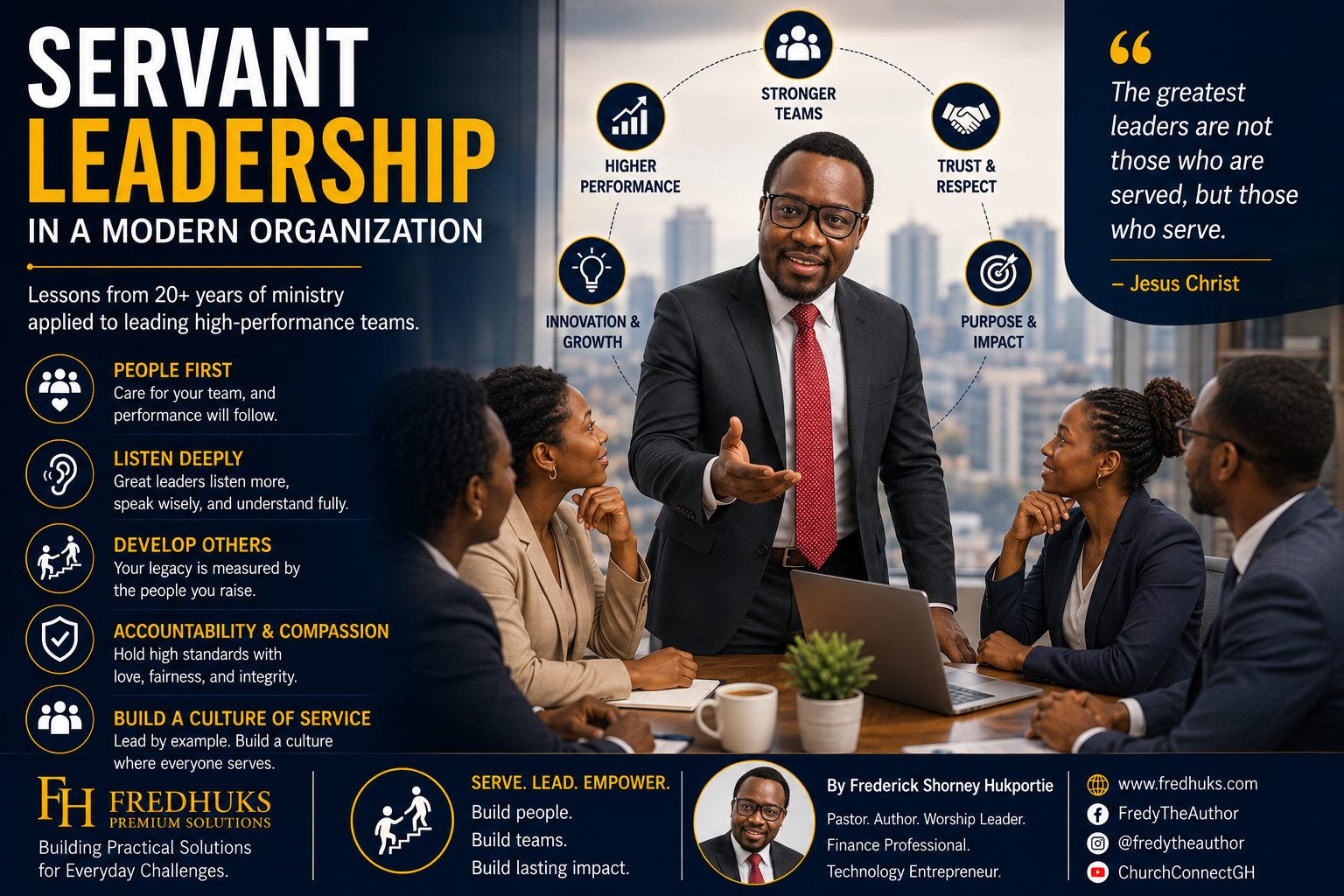
Servant Leadership in a Modern Organization
Lessons from More Than Two Decades of Ministry Applied to Leading High-Performance Teams
Leadership has never been more challenging.
Organizations today operate in an environment characterized by rapid technological change, increasing customer expectations, workforce diversity, and constant pressure to deliver results. In the pursuit of performance, many leaders focus heavily on systems, strategies, targets, and metrics.
While these elements are important, one timeless leadership principle continues to stand out: servant leadership.
Popularized by Robert Greenleaf in the 1970s, servant leadership is based on a simple but powerful idea: the primary role of a leader is to serve. Long before it became a recognized leadership philosophy, this principle was demonstrated by Jesus Christ, who taught that true greatness is found not in being served, but in serving others.
Having spent over two decades in ministry while also working in the corporate world, I have come to appreciate that the principles that build healthy churches are often the same principles that build high-performing teams.
Leadership Is About People First
Many organizations focus heavily on processes and performance. While both are important, sustainable success ultimately depends on people.
In ministry, leaders quickly learn that every individual carries unique strengths, weaknesses, aspirations, and challenges. The same is true in the workplace.
Employees are not merely resources to be managed; they are people to be developed.
When leaders genuinely care about the growth and well-being of their teams, trust increases, engagement improves, and performance naturally follows.
People rarely give their best to leaders who see them only as a means to an end. They willingly give their best to leaders who demonstrate genuine concern for their success.
Influence Is Greater Than Authority
One of the greatest lessons ministry teaches is that position alone does not create influence.
A pastor may hold a title, but people choose whether they will trust, follow, and support that leader. The same principle applies in business.
Modern organizations are increasingly discovering that leadership is less about exercising authority and more about building influence.
Employees respond better to leaders who listen, communicate clearly, and lead by example than to those who rely solely on hierarchy and control.
True leadership is not measured by how many people work under you. It is measured by how many people willingly follow your vision.
Listening Is a Leadership Superpower
Many leaders spend significant time communicating but very little time listening.
In ministry, some of the most important breakthroughs occur not during preaching but during conversations. Listening allows leaders to understand concerns, identify opportunities, and build meaningful relationships.
The same principle applies in organizations.
Team members often possess valuable insights about customers, operations, risks, and opportunities. Leaders who cultivate a culture of listening benefit from perspectives that improve decision-making and innovation.
Listening communicates respect, and people are more likely to support decisions when they feel heard.
Developing People Creates Sustainable Success
One of the most rewarding aspects of ministry is seeing people grow into their potential.
The best leaders do not seek to be indispensable. They seek to develop others.
Organizations that focus solely on short-term performance often struggle with succession, retention, and employee engagement. By contrast, organizations that invest in coaching, mentoring, and employee development create stronger and more resilient teams.
A servant leader asks:
- How can I help this person grow?
- What skills do they need to succeed?
- How can I prepare them for greater responsibility?
When people grow, organizations grow.
Accountability and Compassion Must Coexist
Servant leadership is sometimes misunderstood as being soft or avoiding difficult conversations.
In reality, effective servant leaders balance compassion with accountability.
In ministry, leaders are called to encourage, support, and care for people, but they are also responsible for addressing issues that hinder growth and effectiveness.
Similarly, organizational leaders must hold team members accountable while maintaining dignity and respect.
The goal of accountability is not punishment. It is improvement.
High-performing teams thrive when expectations are clear, standards are consistent, and feedback is delivered constructively.
Building a Culture of Service
Every organization develops a culture, whether intentionally or unintentionally.
Leaders shape culture through their actions more than their words.
When leaders demonstrate humility, integrity, empathy, and a willingness to serve, those values often spread throughout the organization.
A culture of service encourages employees to:
- Support one another.
- Focus on customer needs.
- Take ownership of problems.
- Contribute beyond their job descriptions.
Such cultures are often more collaborative, innovative, and resilient.
Servant Leadership in a Digital Age
Technology continues to transform how organizations operate, but it has not changed what people need from leaders.
Employees still want:
- Trust
- Respect
- Purpose
- Recognition
- Development
- Meaningful relationships
Technology can improve efficiency, but it cannot replace human connection.
As organizations adopt new tools and systems, leaders must ensure that technology enhances rather than diminishes the human experience at work.
The future belongs not only to technologically advanced organizations but also to organizations led by people who understand how to serve.
Final Thoughts
The most effective leaders I have encountered in both ministry and business share a common characteristic: they see leadership as a responsibility rather than a privilege.
Servant leadership does not diminish performance. It strengthens it.
When leaders prioritize people, develop talent, build trust, listen actively, and lead with humility, they create environments where individuals and organizations can thrive.
In a world increasingly focused on power, servant leadership reminds us that the greatest leaders are often those who are most committed to serving others.
Leadership is not about being above people.
It is about helping people rise.