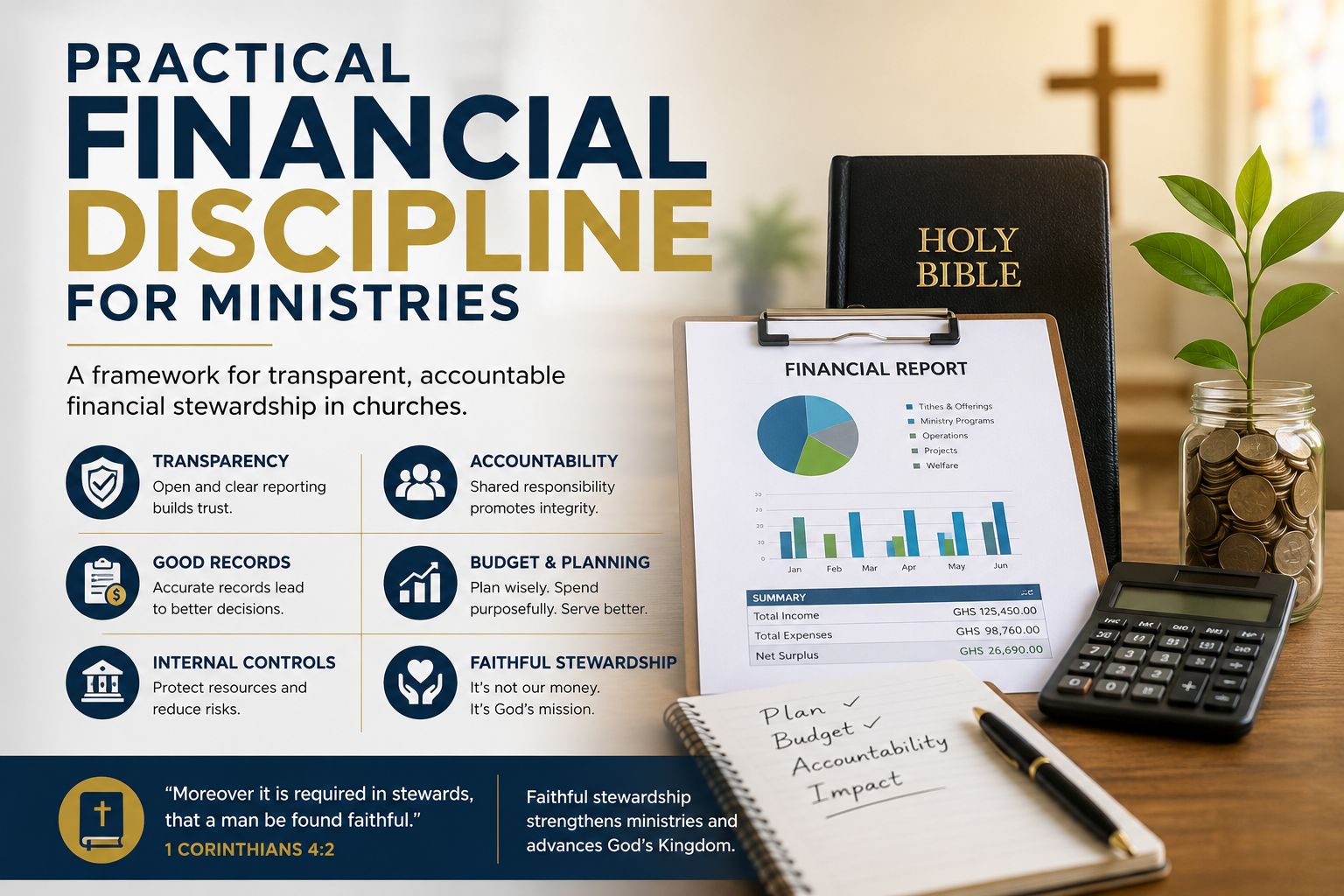
Practical Financial Discipline for Ministries
A Framework for Transparent, Accountable Financial Stewardship in Churches
One of the greatest tests of leadership in ministry is not preaching, teaching, or even church growth—it is stewardship. Every church, regardless of size, is entrusted with resources that belong ultimately to God. The way those resources are managed can either strengthen trust and advance the mission of the church or create confusion, conflict, and reputational damage.
Financial discipline is not merely an administrative responsibility; it is a spiritual obligation. Churches that develop strong financial systems are better positioned to serve their members, support missions, respond to emergencies, and pursue their God-given vision with confidence.
The Biblical Foundation of Financial Stewardship
Scripture consistently teaches that God's people are stewards rather than owners.
In Luke 16:10, Jesus said:
"Whoever can be trusted with very little can also be trusted with much."
Faithfulness in managing finances reflects faithfulness in managing God's work. Churches must therefore treat financial stewardship as an act of worship and obedience.
Common Financial Challenges in Ministries
Many ministries face similar financial challenges:
- Poor record keeping
- Overdependence on one individual for financial decisions
- Lack of transparency in reporting
- Cash handling risks
- Absence of budgets
- Delayed financial reconciliations
- Inadequate internal controls
These issues often arise not from dishonesty but from the absence of clear systems and accountability structures.
A Practical Framework for Financial Discipline
1. Separate Financial Responsibilities
No single individual should control every aspect of church finances.
Responsibilities should be divided among:
- Collection teams
- Finance officers
- Approving authorities
- Auditors or oversight committees
This separation reduces errors and promotes accountability.
2. Maintain Accurate Financial Records
Every income and expenditure should be documented.
This includes:
- Tithes
- Offerings
- Special donations
- Welfare contributions
- Fundraising proceeds
- Ministry expenses
Accurate records provide clarity and enable informed decision-making.
3. Develop and Follow a Budget
A budget is a ministry roadmap for financial resources.
Annual budgets should include:
- Ministry programs
- Missions support
- Administrative expenses
- Welfare activities
- Building projects
- Emergency reserves
Budgets help leaders distinguish between needs and wants while ensuring resources are allocated strategically.
4. Reconcile Finances Regularly
Financial records should be reconciled consistently.
Churches should compare:
- Cash collections
- Bank deposits
- Expense records
- Financial statements
Regular reconciliation helps identify discrepancies before they become major issues.
5. Provide Regular Financial Reports
Transparency builds trust.
Church members should periodically receive appropriate financial summaries showing:
- Total income
- Major expenditure categories
- Ministry investments
- Project updates
When members see responsible stewardship, confidence in leadership increases.
6. Establish Approval Processes
Significant expenditures should follow clear approval procedures.
Questions to consider include:
- Who approves purchases?
- What spending limits require additional approval?
- What documentation is required?
Clear policies protect both leaders and church resources.
7. Build Emergency Reserves
Unexpected situations will arise.
Churches should establish reserves to address:
- Medical emergencies
- Facility repairs
- Community crises
- Ministry disruptions
Financial preparedness enhances ministry stability.
The Role of Technology in Financial Stewardship
Modern technology can significantly improve financial accountability.
Church management systems can help churches:
- Record contributions accurately
- Generate financial reports
- Track expenditures
- Monitor ministry budgets
- Maintain audit trails
- Reduce administrative errors
Digital systems also provide historical records that support long-term planning and transparency.
Creating a Culture of Accountability
Financial discipline is most effective when it becomes part of the church culture.
Leaders should model:
- Integrity
- Openness
- Accountability
- Wise stewardship
When financial accountability is embraced at every level, trust grows and ministry effectiveness increases.
Financial Stewardship as Ministry
Church finances are not merely numbers on a spreadsheet. They represent the sacrifices, faith, and generosity of God's people. Every offering given reflects trust in the church's mission and leadership.
Therefore, financial discipline should never be viewed as a burden. It is a ministry in itself—one that honors God, protects the church, and enables the Gospel to advance.
Churches that embrace transparent and accountable financial stewardship position themselves for sustainable growth, greater impact, and stronger credibility in the communities they serve.
Conclusion
Effective ministry requires effective stewardship. By implementing sound financial controls, maintaining transparency, and embracing accountability, churches can ensure that every resource entrusted to them is used wisely and faithfully.
Strong finances do not replace spiritual power, but they create the stability necessary for ministries to fulfill their calling with excellence. The goal is not simply to manage money well—it is to honor God through faithful stewardship of every resource He provides.