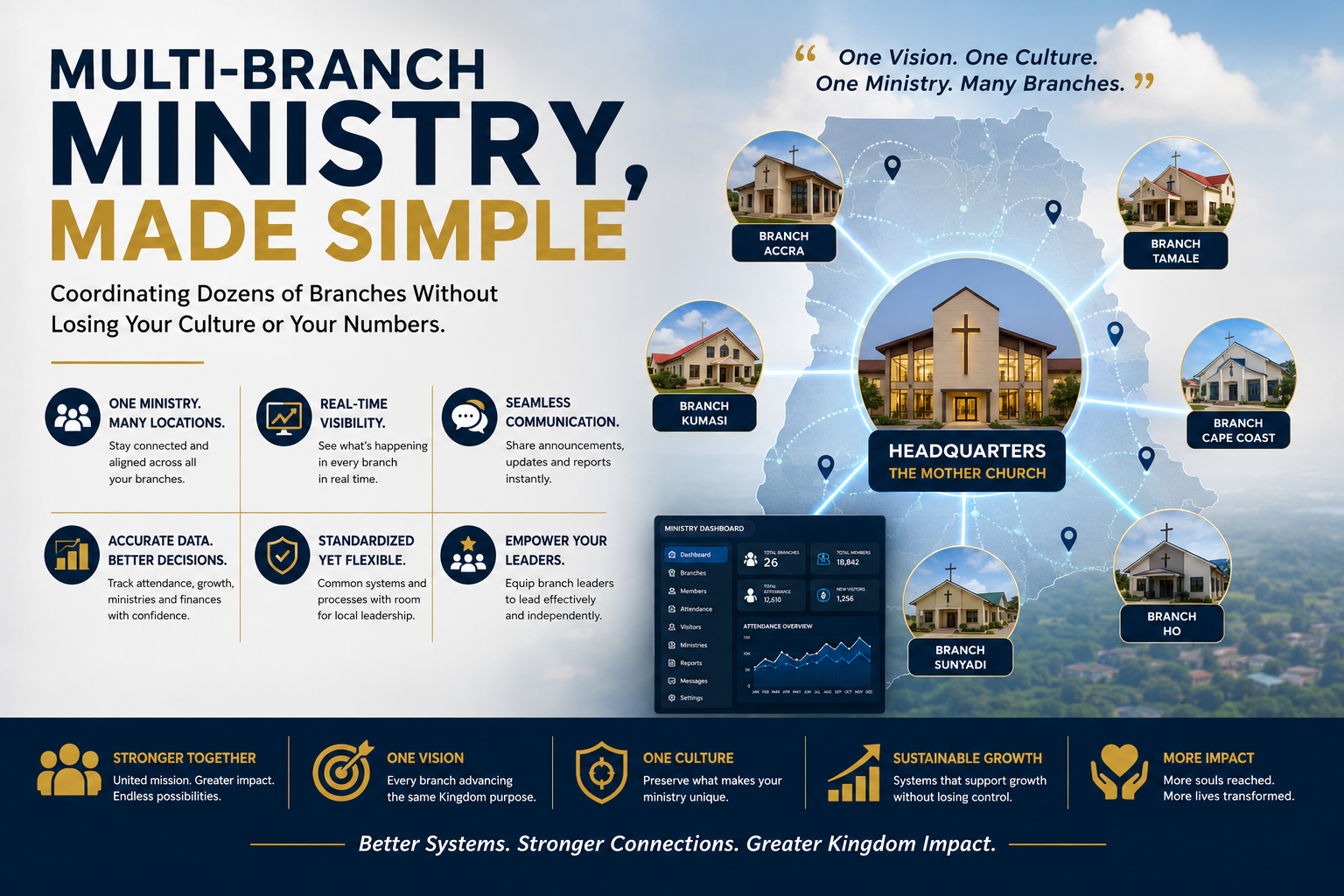
Multi-Branch Ministry, Made Simple
Coordinating Dozens of Branches Without Losing Your Culture or Your Numbers
Growth is one of the clearest signs of a healthy ministry. As churches expand, new branches emerge, new leaders are appointed, and the impact of the ministry extends into new communities. While this growth is exciting, it also introduces a new challenge: maintaining unity, accountability, and culture across multiple locations.
Many ministries discover that managing ten branches is significantly more complex than managing one. Information becomes fragmented, reporting becomes inconsistent, and leadership can struggle to maintain visibility across the entire ministry.
The question is no longer simply how to grow. The question becomes how to grow without losing what made the ministry successful in the first place.
The Multi-Branch Challenge
Every expanding ministry eventually faces similar concerns:
- Inconsistent reporting from branches
- Difficulty tracking attendance trends
- Delayed communication
- Varying administrative standards
- Limited visibility into branch performance
- Loss of organizational culture
- Inaccurate membership records
Without proper systems, growth can create confusion rather than effectiveness.
The goal is not merely to have many branches. The goal is to have many healthy branches operating with shared vision, shared values, and shared accountability.
Culture Must Scale Before Structures
One of the greatest mistakes growing ministries make is focusing solely on structures while neglecting culture.
Buildings can be replicated.
Programs can be replicated.
Systems can be replicated.
Culture cannot be replicated automatically.
Every branch should clearly understand:
- The ministry's mission
- Core values
- Leadership philosophy
- Standards of conduct
- Ministry priorities
When culture is clearly defined and consistently communicated, branches remain aligned even as they grow independently.
Visibility Creates Accountability
Leadership cannot effectively manage what it cannot see.
Many denominational leaders rely on monthly phone calls, spreadsheets, or delayed reports to understand what is happening in various branches.
By the time a problem appears in a report, the issue may have existed for weeks or months.
Modern ministries require real-time visibility into key metrics such as:
- Attendance
- Membership growth
- Visitor engagement
- Ministry activities
- Financial reporting
- Volunteer participation
Visibility enables faster decision-making and stronger support for local branch leaders.
Standardization Without Centralization
A common fear among branch pastors is losing their autonomy.
Healthy multi-branch ministries understand the difference between standardization and centralization.
Standardization means:
- Common reporting structures
- Shared ministry processes
- Unified data collection
- Consistent communication
Centralization means controlling every decision from headquarters.
The goal is not to remove local leadership authority. The goal is to ensure that every branch operates within a framework that supports accountability and excellence.
Communication Is the Lifeline
As ministries grow, communication becomes increasingly important.
Headquarters should be able to communicate effectively with:
- Branch pastors
- Ministry leaders
- Volunteers
- Members
Likewise, branches should be able to communicate important information upward without unnecessary delays.
Strong communication systems help ensure that:
- Announcements are distributed consistently.
- Events are coordinated effectively.
- Emergencies are addressed quickly.
- Leadership remains connected.
Communication is not simply a convenience; it is an operational necessity.
Data-Driven Ministry Leadership
For generations, church leadership decisions were often based solely on observation and intuition.
While spiritual discernment remains essential, modern ministries also benefit from reliable information.
Imagine being able to answer questions such as:
- Which branch is growing fastest?
- Which branch has the highest visitor retention?
- Which departments need additional support?
- Which communities present the greatest outreach opportunities?
Data does not replace spiritual leadership.
It enhances informed decision-making.
The Role of Technology
Technology has transformed how organizations operate, and ministries are no exception.
A well-designed ministry management platform can provide:
- Centralized member records
- Branch-level reporting
- Attendance tracking
- Communication tools
- Visitor management
- Leadership dashboards
- Administrative oversight
Technology allows leaders to spend less time collecting information and more time acting on it.
Empowering Branch Leaders
Growth is sustainable only when leadership is distributed.
Headquarters should focus on:
- Vision
- Strategy
- Oversight
- Support
Branch leaders should be empowered to focus on:
- Pastoral care
- Evangelism
- Discipleship
- Community engagement
When administrative burdens are reduced and reporting becomes simpler, leaders can devote more energy to ministry.
Preserving Culture During Expansion
The most successful multi-branch ministries intentionally protect their culture.
They do this through:
- Leadership development
- Consistent training
- Shared systems
- Clear communication
- Regular engagement
Culture should never be assumed.
It should be cultivated.
The larger a ministry becomes, the more intentional leadership must be about preserving the values that define the organization.
Growth Without Chaos
Growth is a blessing, but unmanaged growth can become a burden.
The ministries that thrive in the future will be those that combine spiritual leadership with operational excellence.
They will embrace systems that provide visibility without micromanagement, accountability without bureaucracy, and structure without stifling local leadership.
The objective is not simply to manage more branches.
The objective is to strengthen the mission of every branch.
Conclusion
Multi-branch ministry does not have to be complicated. With the right culture, communication, leadership structure, and operational systems, ministries can grow confidently while maintaining unity and accountability.
The challenge is not whether growth will occur. The challenge is whether the ministry is prepared to manage that growth effectively.
When branches remain connected, informed, and aligned, growth becomes more than expansion—it becomes multiplication.
And multiplication is where ministry impact truly begins.